Discrete and Continuous Random Variables
A discrete random variable has the following attributes:- Countable number of possible values
- Discrete jumps (or gaps) between successive values
- Counts
- Uncountably infinite number of possible values
- Able to move continuously from value to value
- Measurable such as duration, height, length, speed, value, and weight
Rules of Discrete Probability Distributions
The probability distribution of a discrete random variable X must satisfy the following two conditions:- P(x) ≥ 0 for all values of x
- ∑xP(x) = 1
- [Corollary: 0 ≤ P(x) ≤ 1
Cumulative Distribution Function
The cumulative distribution function, F(x), of a discrete random variable X is defined by the following formula:F(x) = P(X ≤ x) = ∑i ≤ x P(i)
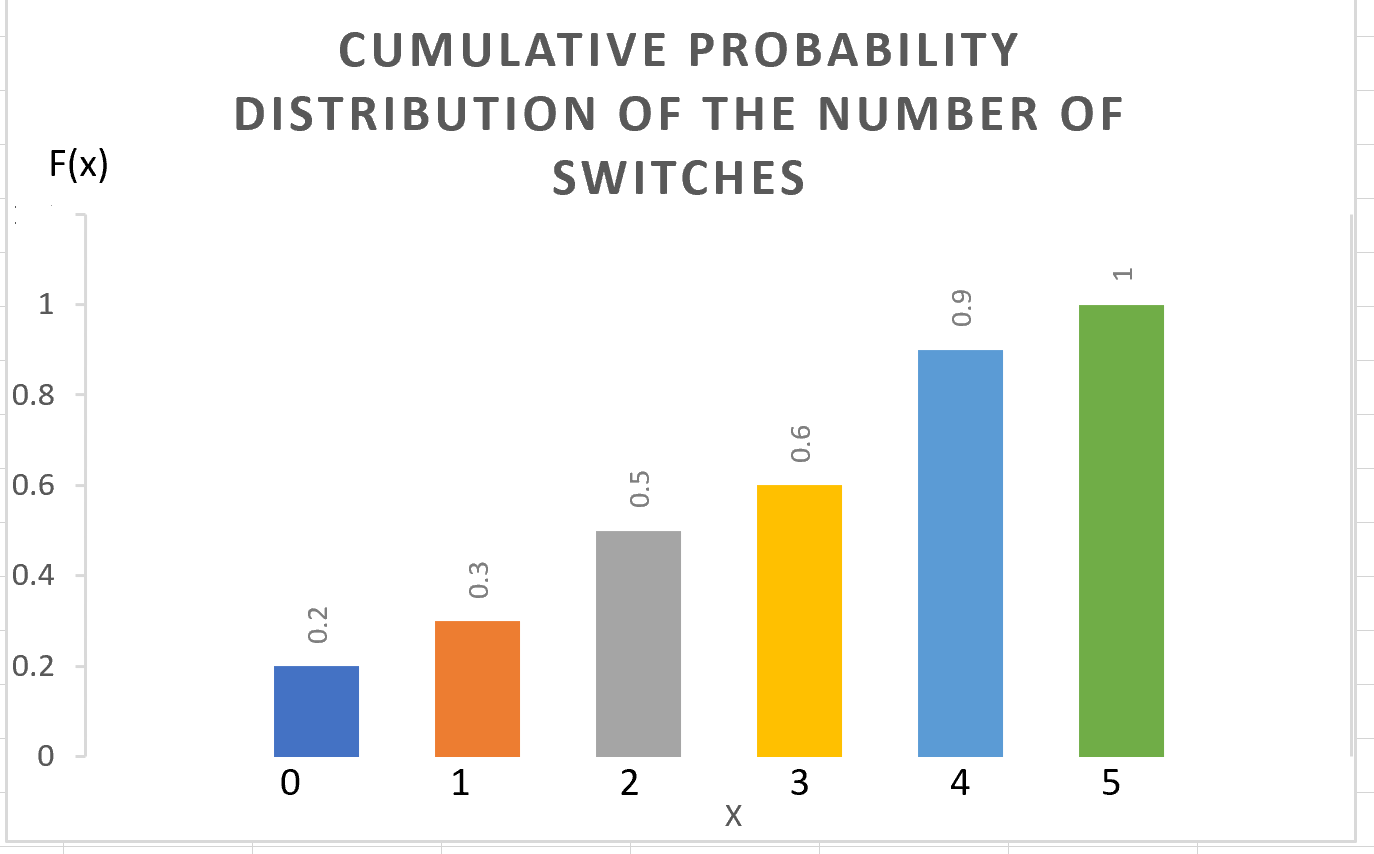
Let's use the example of the number of switches in the following table:
| x | P(x) | F(x) |
|---|---|---|
| 0 | 0.2 | 0.2 |
| 1 | 0.1 | 0.3 |
| 2 | 0.2 | 0.5 |
| 3 | 0.1 | 0.6 |
| 4 | 0.3 | 0.9 |
| 5 | 0.1 | 1.0 |
| 1.0 |
And the graph of the cumulative probability distribution of the number of switches is depicted below: