Introduction
A production function reveals the relationship between the quantity of inputs used to produce a good and the quantity of output of that good.This function can be represented by an equation, graph, or table.
Example 1
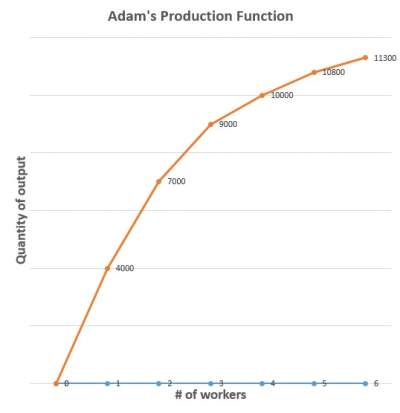
Farmer Adam grows rice in his farm. He has 2 acres of land and can hire as many workers as he needs.Adam's production funtion is shown as follows:
|  |
What is a Marginal Product?
If Adam hires one more worker, his output will increase by the marginal product of labor.The marginal product of any input is the increase in output arising from an additional unit of that input, holding all other inputs constant.
Notation:
ΔQ = change in output, ΔL = change in labor, and Marginal product of labor (MPL) = ΔQ / ΔL
Example 2
| L (# of workers) | Q (Kilograms of rice) | ΔL | ΔQ | MPL |
|---|---|---|---|---|
| 0 | 0 | |||
| 1 | 4000 | |||
| 1 | 4000 | 4000 | ||
| 2 | 7000 | |||
| 1 | 3000 | 3000 | ||
| 3 | 9000 | |||
| 1 | 2000 | 2000 | ||
| 4 | 10000 | |||
| 1 | 1000 | 1000 | ||
| 5 | 10800 | |||
| 1 | 800 | 800 | ||
| 6 | 11300 | |||
| 1 | 500 | 500 |
Why MPL?
Let's assume that Adam would like to hire an additional worker. What are the pros and cons?- The costs will increase by the salary given to the worker
- the output will also increase by MPL, and this helps the business owner to make the right decision
The Reasons Behind MPL Drops Off
- Farmer Adam's output rises by a smaller and smaller amount for each additional worker. Why?
- Whenever Adam hires workers, the average worker has less land to work with and will be less productive.
- So, MPL drops off as L rises whether the fixed input is land or capital including equipment and machines.
- The marginal product of an input drops off as the quantity of the input increases (other things equal)
Example 3: Adam's Costs
- Farmer Adam must pay $2000 per month for the land, no matter how much rice he grows.
- The salary for a farm worker is about $3000 per month.
- So farmer Adam's costs are related to how much rice he produces.
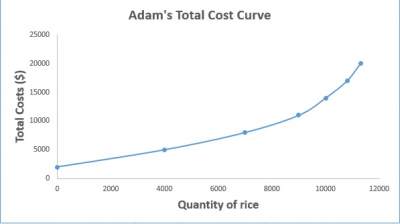
| L (# of workers) | Q (Kilograms of rice) | Cost of Land | Cost of Labor | Total Costs |
|---|---|---|---|---|
| 0 | 0 | $2000 | $0 | $2000 |
| 1 | 4000 | $2000 | $3000 | $5000 |
| 2 | 7000 | $2000 | $6000 | $8000 |
| 3 | 9000 | $2000 | $9000 | $11000 |
| 4 | 10000- | $2000 | $12000 | $14000 |
| 5 | 10800 | $2000 | $15000 | $17000 |
| 6 | 11300 | $2000 | $18000 | $20000 |
|  |
What is a Marginal Cost
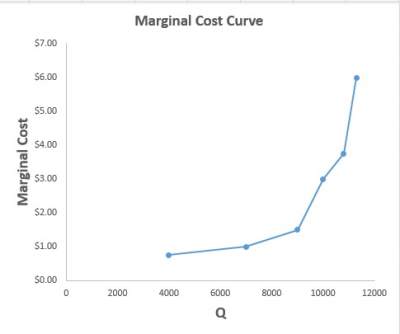
Marginal Cost (MC) is the increase in Total Cost from producing an additional unit. The formula is: MC = ΔTC / ΔQExample 4
| Q (Kilograms of rice) | Total Cost | ΔQ | ΔTC | Marginal Cost (MC) |
|---|---|---|---|---|
| 0 | $2000 | |||
| 4000 | $5000 | |||
| 4000 | $3000 | $0.75 | ||
| 7000 | $8000 | |||
| 3000 | $3000 | $1.00 | ||
| 9000 | $11000 | |||
| 2000 | $3000 | $1.50 | ||
| 10000 | $14000 | |||
| 1000 | $3000 | $3.00 | ||
| 10800 | $17000 | |||
| 800 | $3000 | $3.75 | ||
| 11300 | $20000 | |||
| 500 | $3000 | $6.00 |
|  |
Why MC?
- Let's assume that Adam is rational and wants to maximize his profit.
To increase profit, does he need to produce more or less rice? - Here, Adam needs to think at the margin using the MC.
- If MC is less than the revenue he would get from selling it, then Adam's profits rise if he produces more.