Introduction
Polarity of the bond depends on the ability of one atom to attract the electrons of the bonds towards it more than the other atom.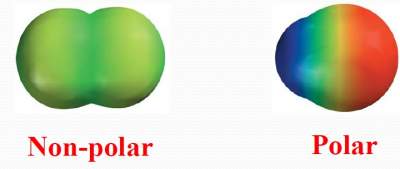
Which is based on the difference in electronegativity between the two atoms making the bond.
A polar molecule does not necessarily contain polar bonds
It is possible for a molecule to contain polar bonds, but not to be polar.
Example: CO2 molecule
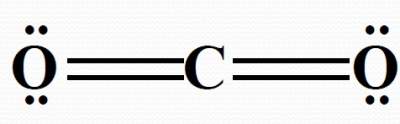
In a CO2 molecule, C−O bond is polar, so both C−O bonds in CO2 are polar, but CO2 is not a polar molecule.
What is the reason behind this?
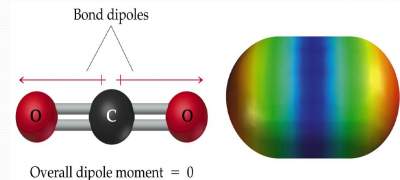
# e domains around C = 2; the molecule has a linear geometry.
The two dipoles are opposite to each other along the same line; they cancel each other.
Example: H2O molecule
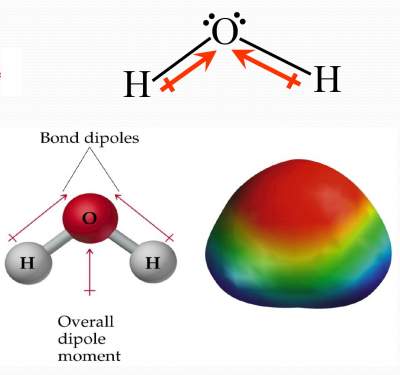
| In a H2O molecule; # e domains around O = 4; hence not linear. Bond dipoles DO NOT cancel each other. So, H2O is a POLAR molecule. |
 |
Exercises on Molecular Shape and Molecular Polarity
Exercise I: Molecular Shape and Molecular PolarityCheck your answers here:
SolutionsExercise II: Molecular Shape and Molecular Polarity
Check your answers here:
Solutions